I have been so angry for so long.
Angry at the horrific cases of murder, rape and abuse of women and children daily in our country.
Angry at how structures that are supposed to protect and support, sometimes exacerbate the pain and trauma of victims and their loved ones.
Angry at the overwhelming reality that loved ones too can be the perpetrators and enablers of violence.
Angry that women themselves choose to perpetuate patriarchal practices out of fear for being labelled disrespectful.
Angry that speaking up is equated with arrogance.
I have been so angry that I allowed my anger to become my silence. Subconsciously, I allowed myself to be conditioned into believing that anger is a negative emotion, as society dictates. And that the way to deal with anger is to suppress it, until you calm down.
But then I read something that shifted my perspective. Anger is an expression of what you feel strongly about and that fiery energy within you should be embraced and channelled in meaningful way.
On Friday, 21 November, I invested my energy in support of Women for Change and joined the movement to declare gender-based violence and femicide – GBVF – as a national disaster. By dressing in black and purple, signing the petition, marching with placards and walking through our streets – thousands of South African men and women added their voices to the call. The waves of support and impactful messages across the country were overwhelming – from NGOs, businesses and individuals, a reminder of what we as South Africans are capable of when we come together. And, we won. The declaration of GBVF as a national disaster was signed the same day.
We must keep the momentum going. As Women for Change says, awareness needs to turn into action and statements must become investments. For me, the 16 Days of Activism for No Violence Against Women and Children, which we are observing currently, needs to become a 365 days way of life. We need to call out misogynistic behaviour the very moment we realise it is happening. We need to stop it before it festers, in our homes, in our circles of family and friends, in our places of work and in South African society at large. It’s these thoughts and attitudes that are at the root of gender-based violence.
If something makes you uncomfortable, even if you aren’t the victim, say it. I have, many times. I have become disliked for it. That’s okay. I’d rather speak truth to power than be liked. You may ask – is it my place to speak up?
Let me ask – what are these places you speak of? You have a place in South African society and with this very society reeling from the tide of violence and abuse against women, no one can deny that it is your place to speak up. We need to own our democracy, a democracy that the women and men who walked before us fought for with their lives. We cannot accept that women and young girls walk our land feeling unsafe and living in fear of becoming the next victim.
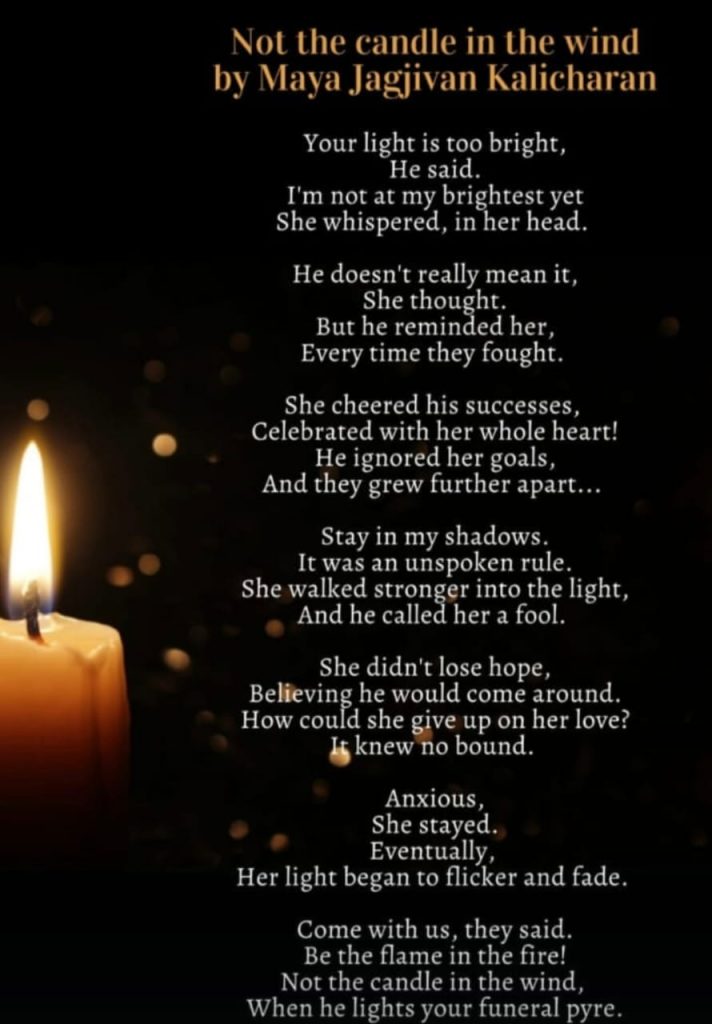
I’m writing this as a reminder not only to you, but to myself. On the evening of 21 November, a memory popped up on my Facebook feed. It was of a poem I wrote 4 years ago on that very day, titled Not the candle in the wind. It still gives me the chills.
Let us honour the women who have faced gender-based violence and the women we have lost to femicide by helping to save other women from the same fate. Every voice can be part of that change. Your voice can be part of that change.